
Disappearing Act
It’s one thing to break into a dead man’s house, or even the house of a fugitive from the law, to search for evidence that can help your case. It’s another entirely to break into the home of a living, presumably law abiding, citizen, especially an officer of the law.
The return trip to the home of Deputy Spiesz took considerably less time, since most of the streets he’d taken earlier were of the common patrol variety.
I might have been a bit heavy-footed about the drive, as well. The task broke a cardinal rule and my blood pressure was up. He was a cop and he wasn’t exactly a suspect. The plan to grab some clue for why the doofus cop made me nervous had me sweating bullets despite the chill air.
But my nagging gut wouldn’t relent. Sadly, Tony wasn’t around to stop me.
Spiesz’s home was a small shotgun-style house, with a rusted mailbox and peeling paint, in a wooded area behind the Historic Village of Eureka. Foothills rose toward the nearby mountains out back and the mailbox address read “463 West Street.”
I shook my head at city planners who established the numbering system for the small municipality.
The Tacoma rolled past the property two extra blocks before I parked.
Avoid the obvious. Homogenize. In the hour just after lunchtime with the weather was unseasonably warm, locals had incentive for a post-meal stroll. At under a thousand people in the whole town, strangers stood out.
The air was crisp, tinged with the scent of pine. The smell of new construction hung in the air, mixing with the organic scents of the bordering woods.
I pulled on a well-traveled, nondescript, working-class coat and a ball cap, hoping to blend in as one more underpaid city employee. Combined with the confident walk of someone who was supposed to be there, I might pull off a prowl inside.
The power meter was at the north end of the house. A quick glance before scooting around to the back, and I found the door unlocked. My elation had the old heart pumping blood oxygen into my brain at maximum, creating a giddy lightheadedness.
Through the back door and into the kitchen, I found the galley layout surprisingly neat, with a potent scent of Pine-Sol cleaner, despite the unkempt exterior of the house. It gave me a brief pause, wondering if Deputy Spiesz had a woman hidden within these walls who handled this level of cleanliness. Or perhaps he had an obsessive need for order to keep confusion to a minimum. Either way, it didn’t matter to me as long as I could find answers.
My blood pumped hot as I foraged through drawers and cabinets seeking clues. The clock above the small refrigerator ticked audibly, like a time bomb in a cartoon reel. I was about to give up hope when I spied a folder tucked behind a stack of dishes in one cabinet.
My heart gave a little jump.
Inside were several documents reviewing Deputy Spiesz’s career as a lawman—training certificates, newspaper clippings where he saved a child, even a handwritten note from some Chief of Police in New York State praising his work ethic. But what caught my attention were two particular pieces of paper—his psychological evaluation and a file photo.
In the photograph, he was young, part of a duo of New York State Troopers who’d saved a drowning child. His partner was an equally young woman who seemed exhilarated over the rescue. It was difficult to tell if the dull-witted Spiesz was glad for a job well done, or excited about the photo op. The picture, with a smile as crooked and pasted on as any from a high school yearbook, accompanied his official graduation shot from the NY State Trooper Academy. Close study of the image stirred a pang of sympathy in my chest at the eternal positivity gleaming from Spiesz’s impressionable eyes.
In both pictures, he appeared confident, proud, genuinely optimistic and bright.
How did he turn into the dullard the Eureka crowd relied on? Had a life surrounded by big city crime, or white collar malfeasance, ripped away optimism for a bright future? Or was it a more dangerous shift in personality?
I quickly scanned the psych eval, looking for red flags, signs that would justify my gut feeling about him being shady. The report showed a clean bill of mental health, no indication of anger issues, no violent tendencies, no criminal indicators. Also, no abnormally low IQ scores. A knot formed in my stomach. Every document indicated an ordinary guy with exceptional dedication. I continued to flip pages, but all I found were glowing reviews from his superiors about his dedication and work ethic. Other than being your run of the mill, all American hero, Spiesz was just an average cop, doing an average job to protect and serve, as boring and unremarkable on paper as he seemed in person.
The whole diversion into Deputy Spiesz’s weird presentation suddenly felt ridiculous. A foolish distraction that took me further away from finding information about Hugh Jenkins’s role in the mysterious land deal with Aidan Peale. Page after page of glowing accolades on the doofus deputy dog, Stan Spiesz, had deterred my investigation.
In the middle of my self-recrimination, my hackles rose. A tremor rattled my spine as I recalled the earlier attack from behind, just this morning. I quashed it by straightening up, arching my back with a little spinal wriggle, and adding a verbal prediction. “Things like that never happen twice in one day.”
Except they do. And it did.
No creak in the floorboards. No shifting shadows in the corners. No telltale smell of death creeping up behind. Nothing but a well-placed wallop next to my ear and the quickly wrapped cloth over my face while I was off balance.
I vaguely remember sucking a breath.
Then black.
Time is a strange construct. Its existence depends primarily on consciousness alone. The idea becomes even more complex during those moments when no one else is around to witness time passing. Does it freeze into one solitary moment? If a man falls in the woods and no one is there to hear him scream, what happens to the hours between states of awareness?
It’s enough to make one question their own sanity. It often keeps me up at night, wondering about the value and significance of each tick of the clock. And what happened to that ticking clock, the one designed to keep me balancing the tightrope between an adrenaline-fueled state of emotional suspicion, and the present moment of cognitive focus?
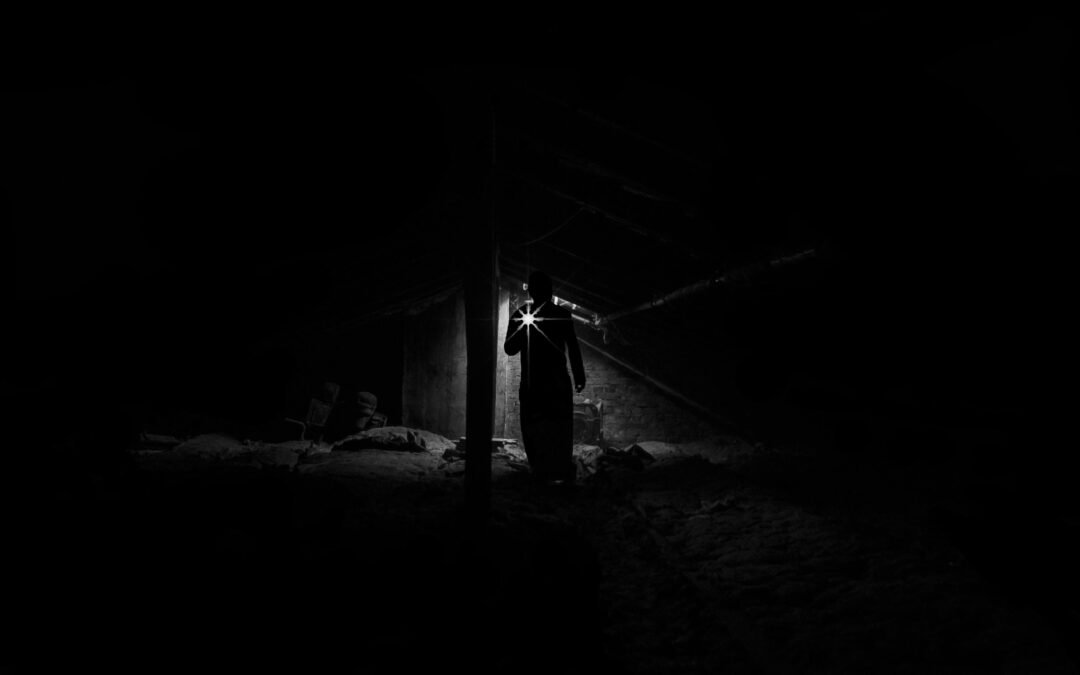
I awoke contemplating time in a dark room with a whopper of a headache. The chloroform kind that keeps you groggy. My mouth and throat were a desert. Nausea formed an oasis of barf, dying to launch itself free of the nightmare that lingered.
Each blink felt like sandpaper against my eyeballs. The stinging caused tears that blurred my dull vision further.
Excessive dryness wasn’t the only thing burning my eyes. I’d been sloppy. Now look at the mess.
I coughed to dislodge confusion. It felt like a hammer at the top of my brain.
The dusty smell of age and disuse came into focus. With it, an awareness that I couldn’t extend my cramped muscles.
My wrists were bound to the arms of an office chair. The wheels had been removed and my feet were tied to the base. The rope had the coarse texture of a lariat, but less refined.
I jiggled against the restraints. They were damn strong. I wasn’t going to break it with sheer strength.
Someone moved behind me.
By the time the hairs on my neck rose to full height, the person had smacked the back of my head twice with what felt like a beaver tail. They punched me in the kidney and the knife-like pain shot madness into me. I gasped to avoid suffocation. A rush of greasy venison filled my nostrils. Their rough sleeve wrapped my neck from behind, the crook of an elbow cutting off oxygen. Nausea choked me. Panic escalated the effort to break free. I rocked and banged the chair legs against the cement floor, my heart beating too fast for the limited air supply.
A muffled and graveled whisper in my ear, “You’re so smart, mister. So smart.” The person squeezed tighter.
I couldn’t tell the size of their arm because of the thick, scratchy coat. But it didn’t matter. The office chair without wheels made it impossible to tip and break free. The homespun rope was strong and tight against my wrists and ankles. The black edge of life was shrinking in on me.
The arm loosened enough to prevent blackout. Then locked down again.
Darkness closed in fast.
“Try this every night,” the gravel voice continued. “Choked out. Toyed with like a cruel kid’s doll baby. Until they tire of you. They sell you like meat. The next kind person finds a new trick. Evil is real. You got to get on the right side of it.”
Man or woman? I couldn’t tell. Heavy material must have covered their mouth. Too hard to distinguish gender. My mind a mess of fog and shadow. Less and less oxygen edged my brain toward a cone of black mist. Sleepy time.
The pressure on my throat subsided. Misty darkness receded. My captor wanted to prolong the torture.
“I got away,” the gritty voice whispered. “I got away by becoming badder than they could be.”
Gag reflex closed my windpipe. Stopped words I could use to distract them, shake them loose or help me figure out what they wanted.
I forced a gulp of air. The sickening scent of dead animal invaded my nasal cavity. I retched.
“Your mother must have let you down pretty badly,” I managed.
Their grip tightened until my eyes bulged.
“I define justice now.” Less a whisper. More masculine. “I will regain the power they stole. More even. Don’t be in my way when it happens.”
They squeezed. The dim light faded. I floated into oblivion, wondering if Nansi would be relieved I died.
Follow on Substack
Best Sellers

Murder of the Prodigal Father
Connor Pierce came home to bury his estranged father. The the details of Dixon Pierce’s perverted last hours add up to murder. Can Connor survive his father’s philandering legacy?

Murder on the East China Sea
Air Force crew chief Connor Pierce wants to help his lonely assistant get comfortable around women. But when the stripper he lets loose on his romantically challenged friend is brutally murdered. . .
Murder on the Edge of the Orient
Connor Pierce is days away from his last day on the island of Okinawa, known to American soldiers as "the Rock." Cornered for one final investigation, things turn bad.
0 Comments