
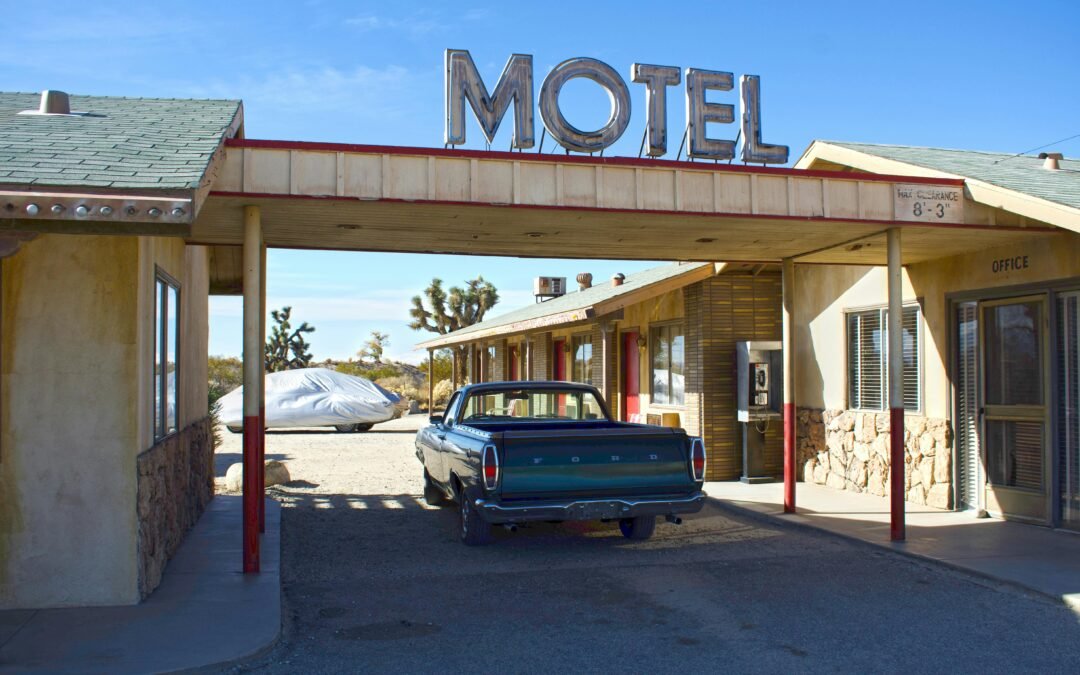
Nickelback Motel
On Faye’s advice, I checked into the Nickelback Motel. She’d told me the owner, Oliver, held a wealth of information about the area. She spoke with a wink, a mischievous glint in her eye, which left me to ponder his potential for exaggerating local lore.
I drove to the motor inn even less sure of what to expect from Eureka, Montana. The bucolic surface image ran contradictory to my reason for coming to this town. Colorful residents looked much more striated when you got up close and personal. Stories of rumrunners, mountain men, Christmas trees and Hollywood actors rattled around in my memory.
But memories of other people’s stories take on a mythical quality. And real folk can never live up to their legendary counterparts.
When Renée first moved up here a few months prior, the place had been a natural topic of conversation with Wilbur Thompson and, surprisingly, with Johnny Horton Martin as well.
Johnny, a man of ambition and pluck, habitually on a quest to build character, was a mover and shaker, a budding builder of empires. He’d spent time in Eureka as a young man working the logs on the river, testing himself. To see “what I was made of” was the way he put it. Once he’d proved his mettle by dancing logs on the river, he took a job with a local cattle rancher. It was here that he crossed paths with the legendary John McIntire, star of Wagon Train, who’d grown up in Eureka and was home for a visit between films. Johnny regaled us with stories about McIntire on our porch when I was a boy, just to wind me up with Hollywood wonder.
The ranch tycoon loved history, especially the history of his beloved Montana. I learned buckets of backstory about this mountain burg before ever climbing into the Tacoma heading west. “The story proper on Eureka began with tobacco and Kootenai Indians,” Johnny told me as we chatted over lunch back in August. “Trappers found it idyllic, chock full of the richness of the times. A breadbasket heaping with warm handmade loaves. Eureka’s foundation was laid out in equal parts tobacco, Native American culture, and the mighty railroad that sliced through the mountains like a well-honed blade.”
Viewed from the roadway, Eureka, Montana had the ramshackle quality of the working class. Made sense that Johnny spoke about the place with nostalgic admiration. This was his kind of settlement, “built on the backs of loggers toiling in the forests, ranchers tending herd, and railroad men laying track through the wild land, it was forged by hard work and sacrifice.”
But I also knew there was a flip side to Johnny’s account. Tales of blood, sweat, and tears. Many of those stories had bleak, tragic endings. Those were the testimonials of the bartender, Wilbur Thompson.
Wilbur countered Johnny’s fascinating narratives of pioneers building community with a bestiary of bootleggers and smugglers—the underbelly of human commerce. He’d stumbled upon Eureka during what he termed his “delinquent stage.” A time of transition from troubled youth to respectable citizen and business owner. Life came hard for the Thompson clan. They scraped and dredged for every meal, according to Wilbur. The opportunity for fast cash sans tariff appealed to the ambitious youngster. A couple of near misses with zealous lawmen combined with a peek at the unsavory dealings in human contraband turned his stomach green, so he took his booty and headed south.
This trip so far contained ingredients more in line with the Wilbur Thompson experience.
“Welcome,” the youngster behind the desk said before the cowbell hanging on the doorknob stopped jangling. He gave me a quick once-over and went back to reading his newspaper, his expression sculpted from marble. Impossible to tell if this lack of emotion resulted from cultural norms or the awkwardness of adolescent hormones running wild. A streak of white ran through his shiny black hair. The tone of his skin suggested Native American, possibly Hispanic. “You must be the detective?”
I smiled. “And you must keep one ear to the ground.”
He didn’t look up. The stooped posture took six inches off his lanky frame.“Need a room?”
“That could work.” I stood at the counter now, looking down. The article in front of him covered the story of a plane crash.
My blood turned icy. Images of my last day on Balls Two Nine, watching her leave the ground with Captain Thaddeus Dollery on stick and Lieutenant Morgan Seago in the Wizzo seat. Mental impressions tumbled like drying socks, tangled memories of the JAG inquiry into my actions as crew chief—nightmares ruptured by saltwater sweat.
The bad omen swamped over me in the second it took the kid to glance up. An acre of forehead and a broad nose separated wide-set eyes. They peered into my soul and suggested a maintenance failure caused the F-15D model training fighter to splash into the ocean waters off the Virginia coast, pilot and weapons officer still strapped in.
“Got dreams to be a flyer,” he said. “Older brother went off to college so he could be a doctor. I gotta watch this place for my uncle,” He thumped the page with the side of his thumb. “Maybe I rethink my career path.” His wide eyes blinked. “A room is it, then?”
“Yes.” I reviewed the wall behind him, pulling a long breath in through my nose to catch the moment. Aerial photos of lakes and mountain meadows. One looked like Eureka from the south. “A queen or a double if there’s a choice,” I said, the frenzied beat of my heart finding a slower rhythm.
“Heard about you.”
That sparked the nerves at the base of my neck. “Stuff you can repeat?”
The kid chuckled, opened a leather-bound paper register and spun it around. “Scratch your name and plate number.” A pen appeared in his hand. He slapped it down. He looked young, but his actions and words made him seem older. Twenties, perhaps. “That Peale family, that’s a crap-pile to step in,” he said. “Those two are heel-biters.”
“You know them well?” I asked while jotting my tag number.
“As well as I know a dog that bites.”
“Aidan dangerous?”
The question made the boy stare out the window. “Never considered. Don’t think so.”
“I planned to pay a visit after checking in.”
His nod was sharp and precise, like a military salute. “Aidan Peale,” he said, voice low and thick with intrigue. “He’s what Uncle Gerulis calls a spirit mind—a medicine man without self control.” He leaned in closer, his dark eyes glinting with danger. “Goes about reading a person’s aura, making their secrets public. And when he has that dream fever, he believes he is a king of a castle. We are his subjects.” His sardonic smile shifted to one that was bright and teasing. “I have to admit, he makes an excellent White man.”
I chuckled with a gentle head shake. “Might be the woman makes him crazy.”
“Yes,” he agreed with a quick grimace. “She has a way. Hungry for young bucks. Unpredictable.”
He set the grin back to high beams and handed over a room key. “Number thirty-seven. Down on the right.”
“You have maybe fifteen rooms,” I said before I could stop myself.
“You’re a good detective.” He said it with a straight face, but those mischievous eyes twinkled a bit. His expression became somber. “I hope you find the child,” he said. “She is the finest of that pack.” He went back to the article.
I got the impression our exchange was complete. No part of me wanted to discuss downed aircraft. Especially his missed opportunity to crash a jet fighter into the ocean.
The room was exactly where he said. Right after twenty-four. Next to sixty-five.
A simple, honest room. Double bed, two-drawer bureau with a small television on top in front of a large mirror. Single nightstand with a red LED alarm clock and a black rotary dial phone, complete with laminated card cataloging local services. All wrapped in the smell of disinfectant. Nothing extra. Frugal. Let criminal types and vacationers waste money in the resort up the road.
“Or honeymooners,” I said to no-one, recalling Vicky and Renée’s alibi in said resort.
The chill of concrete prompted me to crank the wall-mounted heater up to seventy degrees. Its whir doubled as a sound machine. An unnecessary accoutrement, except to cover the occasional whine of eighteen wheels heading north to the border.
I sat on the firm mattress and poked the speed dial on my Nokia.
Nansi asked if I’d found the child. I told her I was going to visit the father’s house before lunch, and I might find the little girl playing in his yard and be home by midnight tomorrow. She harrumphed.
“She likes unicorns,” I said. The words triggered a gentle smile I could hear in her voice, a familial warmth that smoothed some of the edge off.
I mentioned the few dollars Lorna and Renée had scraped together until Vicky could get to the bank.
“Just hurry,” she said.
“I love you,” I said.
“I know,” she replied before ending the call.
I stared at the black brick in my hand, wishing it could teleport me back to sanity.